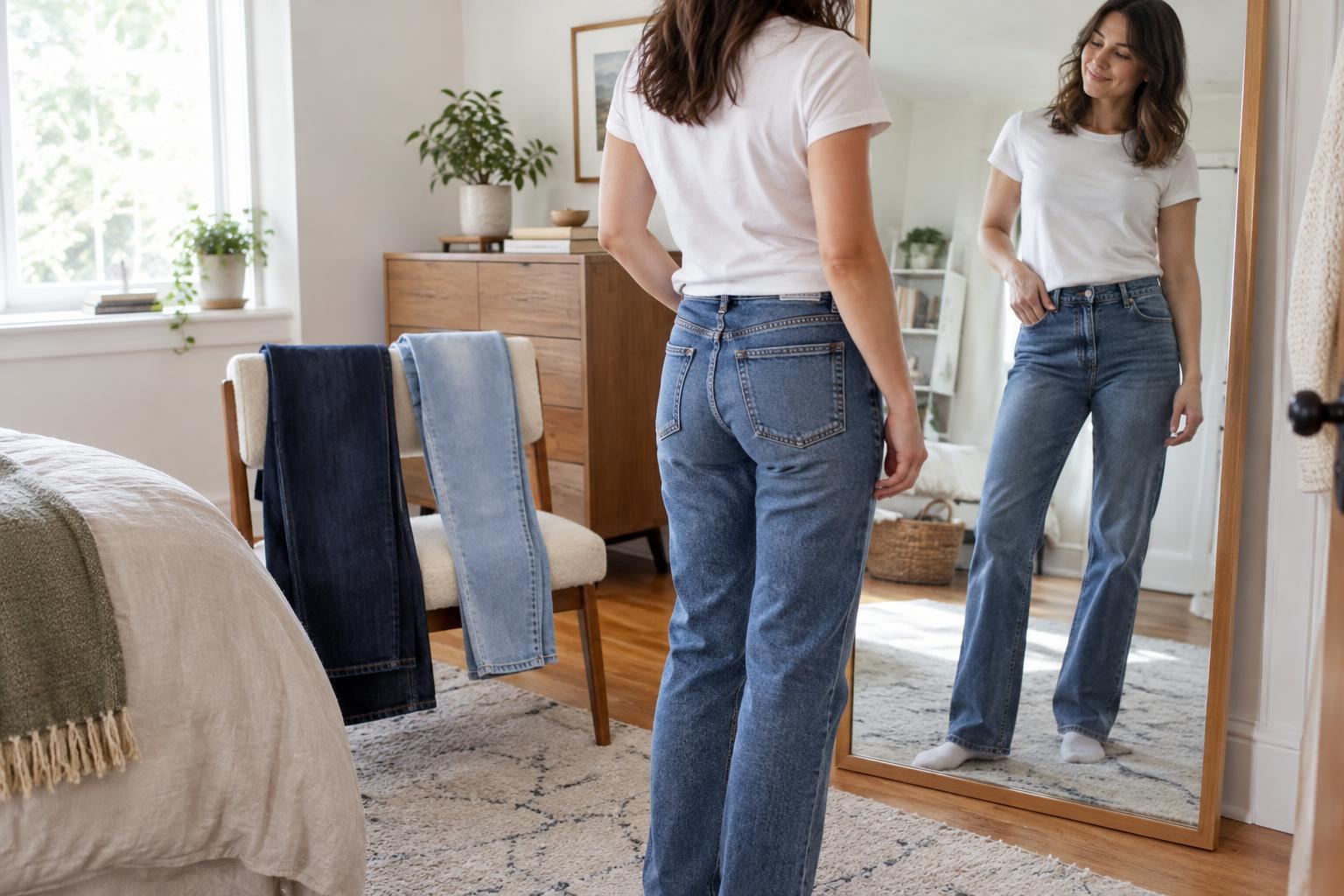
Start with the day you want the jeans to handle
Before looking at cuts, picture where you will wear your jeans. A pair for a long commute or a day spent sitting may need a different feel from one you mainly wear for short outings. Think about the shoes you reach for, the tops you like to tuck or leave loose, and whether you prefer a close fit or room to move. These preferences are more useful than trying to identify one universally flattering shape.
Choose a familiar pair as a starting point, even if it is not perfect. Notice what you would keep and what you would change: perhaps the waistband stays put but the thighs feel tight, or the legs feel right but the hem catches under your shoes. That gives you a short list to work from when product names and fit descriptions become confusing.
Understand what rise changes
Rise describes how high the waistband sits between the crotch seam and your waist. Low-rise jeans sit lower on the hips, mid-rise jeans usually sit between the hips and natural waist, and high-rise jeans reach closer to or above the natural waist. Labels vary by brand, so treat them as a guide rather than a precise measurement.
The best rise is the one that feels secure when you move. Try sitting, bending and walking. If the waistband digs in when seated, slips when you stand, or gaps more than you like at the back, compare another size or cut. A higher rise may give you more coverage when you sit; a lower rise may feel less restrictive around your waist. Neither is automatically more comfortable for everyone.
Consider how rise works with your usual tops. If you often tuck in a shirt, a waistband that stays smooth and comfortable will matter. If you wear longer, untucked layers, you may care more about how the jeans feel than where the waistband appears. You do not need to choose a rise based on a rule about your body shape.
Choose a leg shape for movement and balance
Leg shape describes how the jeans fit from thigh to hem. Straight-leg jeans keep a fairly consistent width and can be an easy place to start. Slim jeans sit closer to the leg without necessarily clinging. Wide-leg jeans offer more room through the leg, while tapered styles narrow toward the ankle. A bootcut has a slight widening below the knee. These terms can overlap, so look at the actual outline rather than relying on the name alone.
Pay particular attention to where you want room. If jeans pull across your thighs when you sit, a wider thigh may help even if you like a narrow ankle. If fabric bunches around your lower legs, a straighter or more tapered cut may give you the line you prefer. Check the hem with the shoes you expect to wear most often. An ankle-length pair may work well with low-profile shoes, while a longer, wider leg may need more care to avoid dragging.
Changing leg shape can make a familiar outfit feel different without replacing everything else. Try two cuts with the same top and shoes, then notice which combination feels easiest to wear. Comfort and personal taste are enough reason to choose one over the other.
Read the fabric and fit together
Denim feel depends partly on fabric composition and weight. Jeans with stretch can feel more flexible right away, especially when sitting, but stretch does not fix a waistband that is the wrong size or seams that sit awkwardly. Jeans made mostly or entirely from cotton may feel firmer at first. They may soften with wear, though you should not count on an uncomfortable pair changing enough to become a good fit.
When trying jeans on, check the waistband, seat, thighs and knees separately. You should be able to sit normally, take a comfortable step and bend without repeatedly adjusting them. Some creasing is ordinary; persistent pinching, slipping or pulling is more useful information. If you are between sizes, compare both after moving around rather than judging only how they look while standing still.
Make the final check a practical one
Once you find a promising pair, try it with an everyday outfit instead of an imagined occasion. Look at the hem in your usual shoes, test whether a tucked or untucked top sits as you want it to, and spend a few minutes seated. If you are shopping online, compare the garment measurements with jeans you own and check the fabric description and return terms before ordering.
A useful pair does not have to meet every trend or fit ideal. It needs to stay comfortable through the activities you bought it for and work with clothes you already enjoy wearing. Rise, leg shape and fabric are simply tools for narrowing the search until the jeans feel like an easy choice.