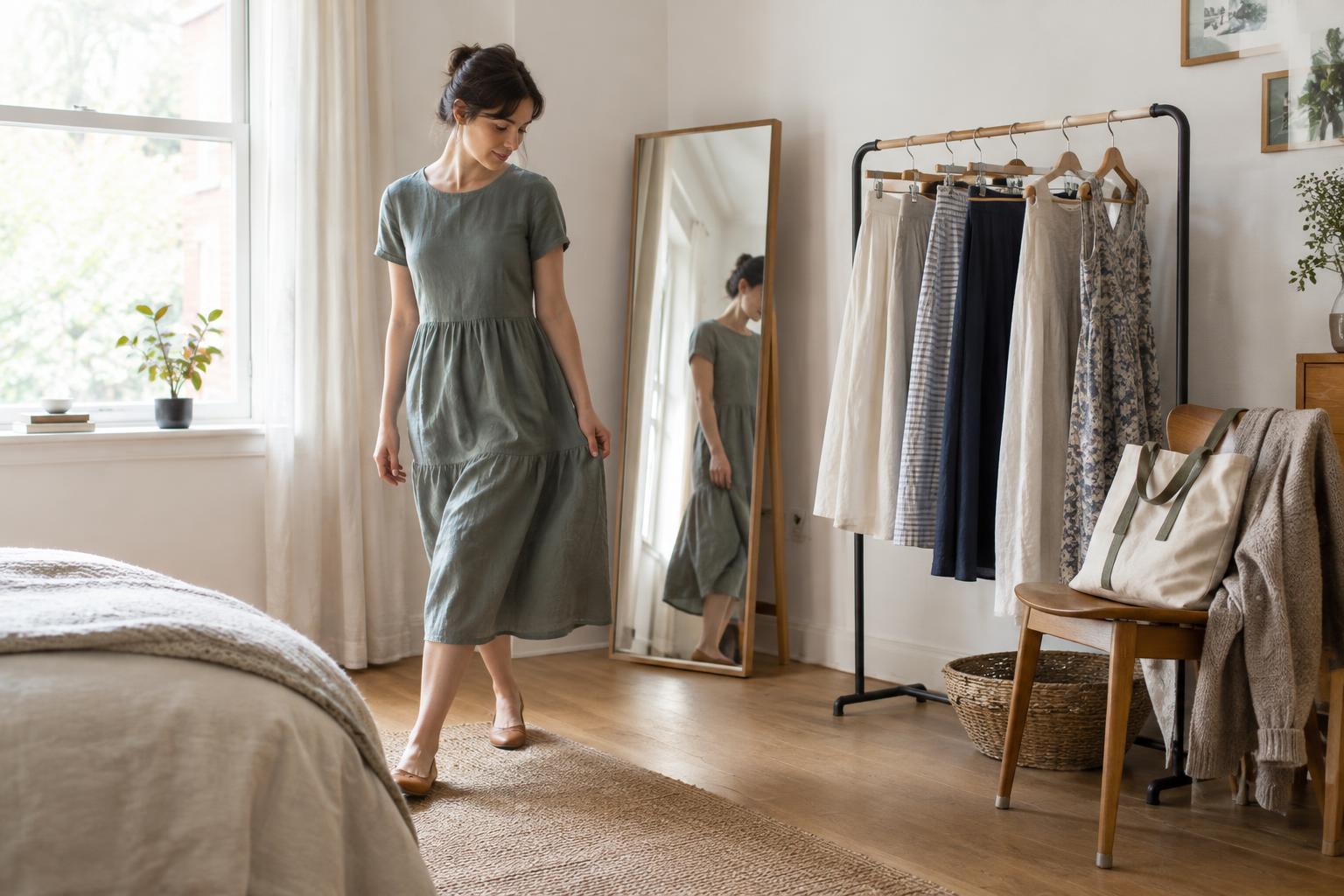
Start with an ordinary day, not an ideal outfit
Before choosing a dress or skirt, think through a day you actually have. Do you walk between places, sit for long stretches, carry a bag, bend to pick things up or move between warm and cool rooms? A piece that looks appealing on a hanger may feel less useful if you have to keep adjusting it. The aim is not to find one shape that works for everyone, but to identify what lets you get on with your day.
Consider where you would wear the piece and what you already own to wear with it. If your usual shoes and layers work with it, you are more likely to reach for it. If it needs a special jacket, different shoes and a bag you do not have, pause before buying. Trying a new style can be fun; it helps to know whether you are choosing an everyday option or an occasional one.
Check how the shape behaves when you move
A dress needs to fit comfortably through every area that affects movement, not just at the waist. If you have to pull at the shoulders when reaching forward, or the buttons strain when you sit, a different size or cut may serve you better. Wrap styles may allow adjustment but can shift as you move; button-front and fitted styles may be worth checking for gaps. Notice whether a belt stays in place or needs frequent retightening.
With a skirt, pay attention to both the waistband and the space around your legs. Walk, sit and take a few steps up if you can. A narrow skirt might need a vent for an easy stride, while a fuller skirt may move more than you expect in a breeze. Length is personal, so test it in the positions that matter to you rather than relying on how it looks while standing still.
Choose fabric for comfort and upkeep
Fabric changes how a dress or skirt feels throughout the day. A softer material may drape easily, while a crisper one may hold its shape. Lighter fabrics can feel comfortable in warmth but may be more revealing in strong light or cling to tights. Heavier fabrics can offer structure yet feel less comfortable in a warm room. If possible, look at the garment in natural light and check how it feels against your skin.
Think about care before committing. Read the care label, and consider whether the recommended washing, drying or ironing fits your routine. A piece that wrinkles readily is not necessarily a poor choice, but it may be frustrating if you want to put it on straight from the wardrobe. If a garment has a lining, check that it feels comfortable, lies smoothly and does not make the piece harder to care for than you would like.
Notice the small details that affect wearability
Pockets can be useful, but their placement and size matter. Put your hands in them and see whether they pull the fabric out of shape. Check zips, buttons and fastenings for ease of use, especially if you will often get dressed in a hurry. If a waistband is elasticated, make sure it stays comfortable after you have been seated for a while. These details are easy to overlook in a quick try-on.
Also look for anything you would need to manage repeatedly: a neckline that slips, straps that show when you do not want them to, or a hem that catches on your bag. None of these is automatically a reason to reject a piece. The question is whether you are happy to make that adjustment as part of wearing it. A comfortable outfit should leave most of your attention free for the rest of your day.
Make it work with what you already wear
Before keeping a new piece, try it with two or three combinations from your own wardrobe. A dress might work with your usual flat shoes and an open shirt or cardigan. A skirt might pair easily with a familiar T-shirt and a tucked or untucked knit. You do not need a different outfit for every occasion; a few reliable combinations can make the piece feel like a natural part of your wardrobe.
Give yourself a short wear test at home if you can. Sit, walk, carry your everyday bag and notice whether you forget about the garment or keep fixing it. That experience can tell you more than a mirror check alone. The best everyday choice is not necessarily the most versatile item in theory. It is one you feel comfortable wearing for the ordinary activities that fill your week.