Start with what catches your attention
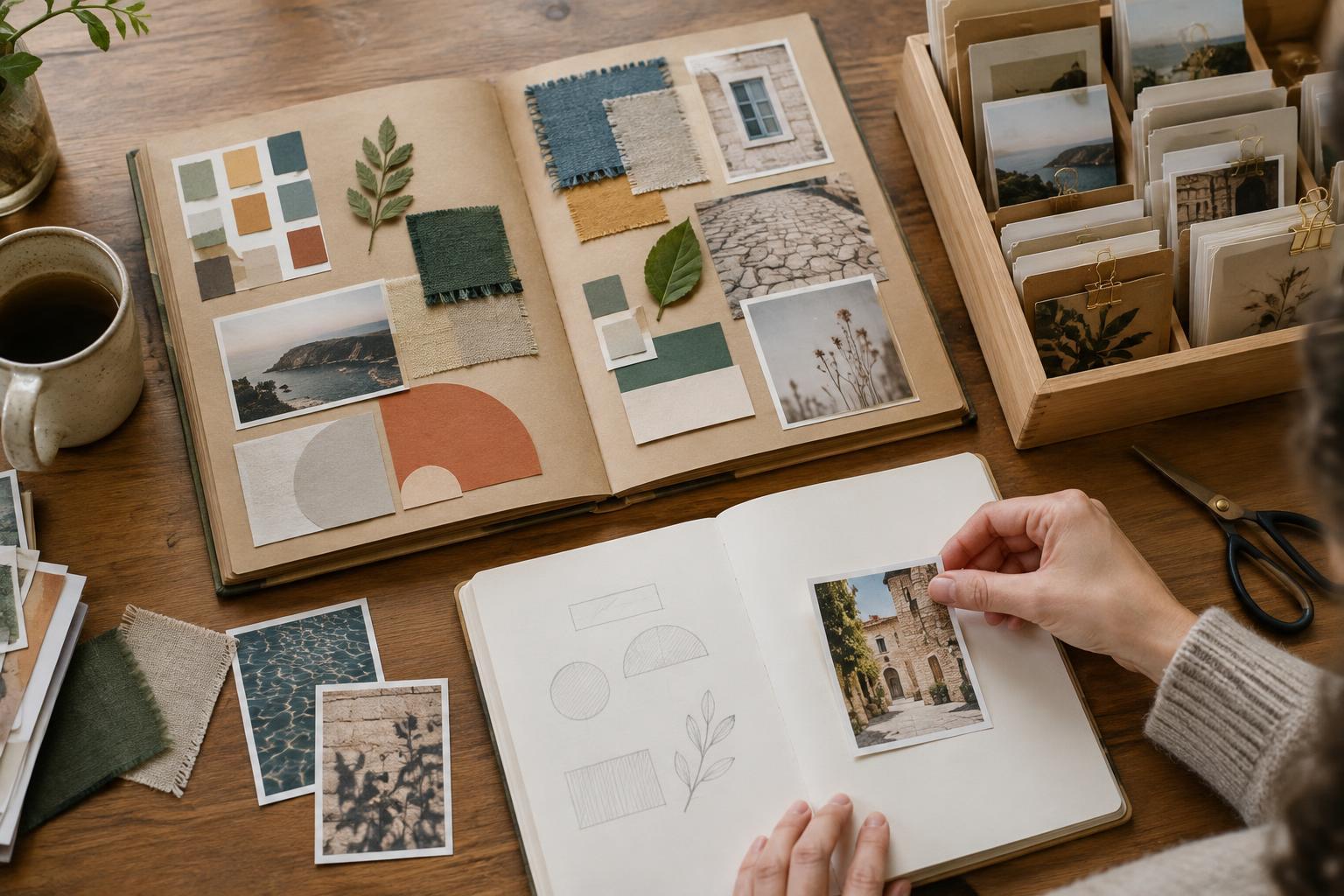
A creative reference library is a place to keep things you may want to look at again: a color combination, an interesting shape, a line of dialogue you overheard or a room layout that feels welcoming. It does not need to be impressive or complete. Its job is to help you notice what interests you and make those observations easy to find when you want to create.
Choose one main place for your collection. A notebook works well if you like to draw or write by hand; a folder on your phone or computer is convenient for photos and screenshots. You can use both, but give each a clear purpose. For example, keep quick observations in a pocket notebook and store visual references in one digital folder. Starting with a system you already know is usually easier than setting up a complicated new one.
For a week, collect only things that genuinely make you pause. You might photograph the shadows on a wall, note the texture of a worn jacket or save the colors from a café menu. Include a short reminder of what caught your eye. “Warm colors against gray” will be more useful later than an unlabeled image you can barely remember saving.
Give your collection a light structure
A reference library becomes harder to use when every item lands in one long, unsorted list. Begin with a few broad categories based on what you make or hope to try. A writer might use Characters, Settings and Conversations. Someone interested in visual projects might choose Color, Shapes, Texture and Layout. These categories can change as your interests change.
Keep the sorting process quick. When you add something, place it in the closest category and write a few words about its appeal. If an item fits in several places, pick one rather than creating extra folders. You are building a tool for finding ideas, not an archive that has to be perfectly cataloged.
It can also help to separate references from possible projects. “Blue and orange shopfront” is a reference; “make a small collage using those colors” is a project idea. Keeping those notes distinct lets you enjoy collecting without feeling that every observation has become another task.
Look for patterns without forcing a theme
After you have collected a modest handful of items, browse them together. What appears more than once? Perhaps you keep noticing narrow doorways, handwritten signs, quiet interiors or bold stripes. Repetition may point toward a subject or style you would enjoy exploring, even if you could not have named it when you began.
Try writing one sentence about a pattern you notice: “I like spaces that feel lived in,” or “I keep saving simple shapes in bright colors.” This is not a rule for what you must make next. It is a clue that can help you choose a direction when a blank page feels too open.
Not every saved item needs to fit the pattern. A surprising reference can be especially useful because it interrupts your usual choices. Leave room for things you cannot explain yet, while letting go of items that no longer interest you. A small collection you enjoy revisiting is more helpful than a large one you avoid opening.
Turn references into small experiments
When you are ready to make something, choose one or two references and ask what you can borrow as a starting point. You might use the rhythm of a conversation to write a fictional exchange, adapt the colors of a street scene for a painting or arrange paper shapes around the outline of a building. Aim to explore a quality you noticed rather than reproduce the original item.
Give yourself a small, finishable task. Spend fifteen minutes sketching variations on a shape, write a paragraph set in a place with a similar atmosphere or make three tiny color studies. Small experiments help you find out which references hold your interest before you commit to a larger project.
If a reference is someone else’s creative work, keep a clear distinction between studying it and presenting a close copy as your own. You can note what you admire, then change the subject, materials or approach as you develop your idea. Your own observations and choices are what make the experiment useful.
Keep it useful, not endless
Set aside a few minutes now and then to revisit your library. Remove duplicates, add missing notes and move one promising idea into your project list. You do not need to review everything at once. Even looking through a single category can remind you of something you wanted to try.
If collecting starts to take more time than creating, pause the saving habit for a while. Pick one item already in your library and make a rough response to it. The result does not have to be something you keep. A reference library earns its place in your routine when it helps you move from noticing to making, one manageable experiment at a time.